
Most PAYGO and BNPL smartphone operations don’t have a collections problem, they have a systems problem.
These models have unlocked significant growth across emerging markets. Operators are scaling device financing, expanding distribution networks, and reaching previously underserved customers. On the surface, the model works.
But as operations grow, a different challenge emerges, not in the strategy, but in the infrastructure underneath it.
The fragmentation problem
Most operators run their business across a combination of systems: a CRM for customer management, mobile money or payment gateways for collections, and field tools for onboarding and agent activity. This is true whether you are running a PAYGO model, a BNPL program, or a hybrid phones-on-credit operation. Each plays a role, but they are rarely designed to operate as a single connected workflow.The result is an operation that functions in parts rather than as a whole.
A payment processed through mobile money may not immediately update the system controlling device status. Onboarding data may be incomplete or inconsistent across platforms. Field agents may be working from outdated information, affecting both conversion rates and collections outcomes. None of these issues are catastrophic in isolation, but together they create friction across the entire operation.
Over time, that friction becomes measurable. Collections cycles slow, default rates increase and decision-making becomes less reliable as data consistency breaks down. According to the GSMA, digitized and integrated field operations are a core enabler of scale in last-mile distribution models, particularly in markets where payment infrastructure and connectivity are still maturing.
Adding tools is not the same as adding connectivity
A common response to these challenges is to introduce additional tools: a better CRM, a new payment provider, a separate system for field tracking. Each may solve a specific problem. But without integration as the foundation, every new tool adds another layer that needs to communicate with the rest of the stack, and fragmentation deepens rather than resolves.
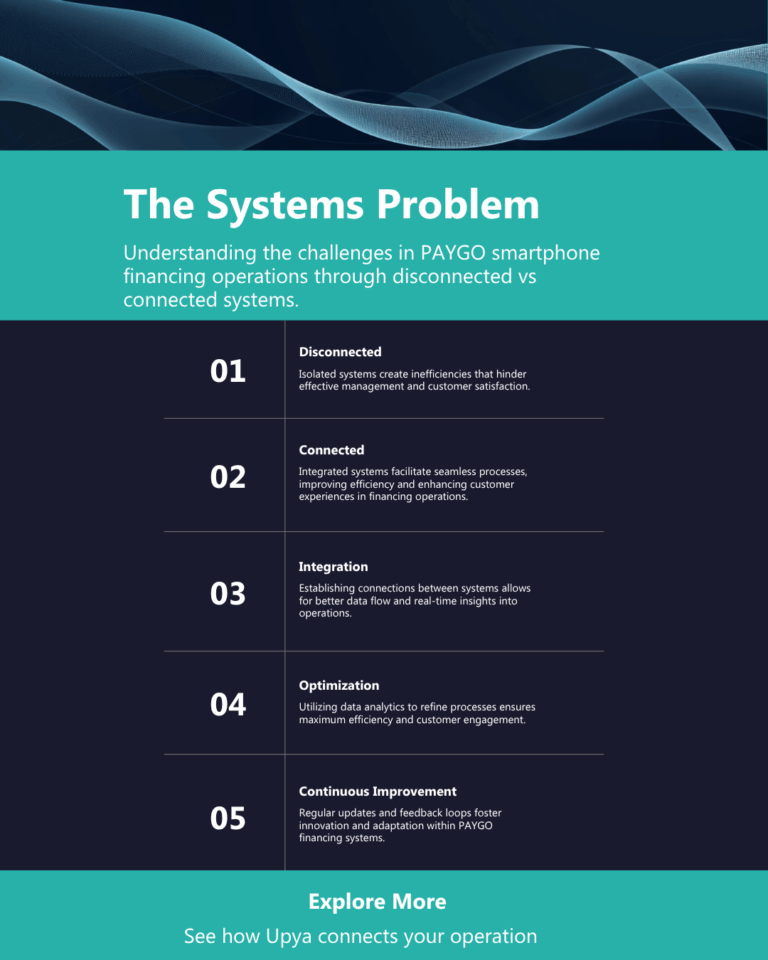
The conversation has shifted as a result. The question is no longer whether an operator has the right tools. It is whether those tools are capable of working together as a unified system. In PAYGO and smartphone financing operations, where payment status, device control, and customer data must stay synchronized in real time, this is not an optimization question. It is a structural one.
What a connected operation looks like
When systems are designed to integrate, the operational dynamic changes entirely, for PAYGO operators, BNPL providers, and any financing model where device control and payment status must stay in sync. Payments are reflected in real time, triggering automated actions—device lock or unlock—without manual intervention. Customer onboarding becomes more consistent, improving the quality of credit decisions. Field teams operate with accurate, current information, reducing errors and improving productivity. At the management level, a single reliable view of the operation enables faster and more confident decisions.
This is what it means to be built to connect. Integration is not a technical feature added on top of an existing stack. It is the foundation on which scalable PAYGO and smartphone financing operations are built. Operators that invest in connected infrastructure are better positioned to grow with control and consistency. Those that continue to rely on disconnected tools will encounter compounding inefficiencies as volumes increase.
The GSMA’s work on digital financial services and last-mile distribution consistently points to interoperability and real-time data synchronization as critical enablers of sustainable scale in emerging markets.
How Upya is built for this
Upya connects onboarding, loan management, payments, field operations, and device control within a single platform, built for PAYGO, BNPL, and phones-on-credit operations across emerging markets. Where external connections are required, open APIs allow the platform to integrate with the tools already in your stack, without adding complexity. Operators don’t need to choose between best-in-class tools and operational simplicity. The platform is designed to handle both.
If your current setup relies on systems that don’t fully communicate, the cost is likely already visible in your collections cycle, your data quality, and your team’s ability to make fast decisions in the field.
That is the problem connected infrastructure solves.
Interested in seeing how it works in practice? Book a demo