
Across Nigeria and Côte d’Ivoire, Lumos operates in markets where nearly one billion Africans still lack reliable electricity. Running large field operations in this context, spanning sales agents, warehouse teams, verification units, and customer service demands coordination, speed, and accuracy. Furthermore, many organizations remain stuck with semi-digital processes that limit their ability to scale.
Why Lumos chose to digitalize
Lumos recognised that to grow sustainably, they needed to move beyond spreadsheets, manual approvals, and fragmented communication. Their goal wasn’t to “add software.” It was to rethink how teams work together, reduce operational bottlenecks, and improve customer experience. As a result, they Partnered with Upya, to transform everything from customer onboarding to after-sales service and inventory management.
Digital transformation is more than technology
The shift to fully automated workflows required more than technical deployment. It involved leadership alignment, organisational change, and continuous learning. Ultimately, Lumos’s experience shows that digitalization succeeds when people, processes, and technology evolve together.
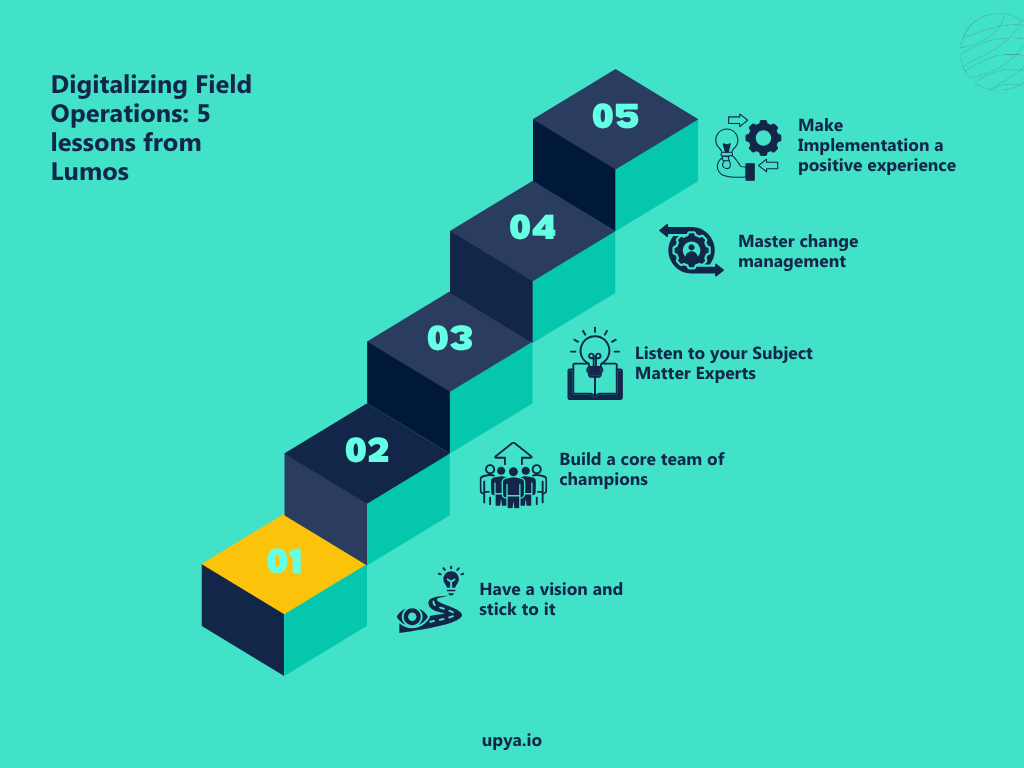
Have a vision and stick to it
Successful digital transformation of field operations starts at the top. Lumos’s leadership—CTO Tunde Salimonu and CEO Alistair Gordon—provided clarity, direction, and unwavering support throughout the process. In addition, they championed the project publicly and reinforced momentum during difficult phases.
Their role extended beyond approvals. They guided the organisation through early challenges and aligned teams around a long-term vision.
Why this matters:
Field digitalization projects meet resistance, especially from teams comfortable with current processes. Without strong leadership, digitalization often stalls long before reaching scale.
What to do:
- Ensure C-suite leaders can articulate why digitalization matters to business outcomes
- Give leadership visibility into implementation progress through regular updates
- Empower them to address roadblocks and resistance decisively
- Make digitalization a strategic priority, not just an IT initiative
As CEO Alistair Gordon reflected: “Our partnership with Upya allowed us to move to a dynamic, scalable platform that supports our long-term growth. The impact on productivity, service delivery, internal and field team coordination has been game-changing.”
As CEO Alistair Gordon reflected: "Our partnership with Upya allowed us to move to a dynamic, scalable platform that supports our long-term growth. The impact on productivity, service delivery, internal and field team coordination has been game-changing."
Alistair Gordon Tweet
Build a core team of champions
Lumos succeeded because they created a powerful dual-champion model: Upya Champions inside Lumos and Lumos Champions inside Upya. Together, these champions understood both the business context and the technology.
Why this matters: as operational complexity grows, miscommunication becomes costly. Therefore, Champions bridge this gap, reduce context loss, accelerate problem resolution, and maintain alignment.
What to do:
Appoint 3–5 champions across operations, IT, and field management.
Give them authority to drive the digitalization agenda.
Set up a dedicated communication channel between champions and your tech partner.
Recognize their contributions to boost morale and adoption.
Listen to your SMEs, they know what actually happens
Digital workflows only work when they reflect operational reality. Lumos ensured Subject Matter Experts (SMEs) shaped the design of every workflow. Moreover, SMEs provided insights into exceptions, workarounds, and field challenges that leadership might not fully see.
SMEs answered the critical question:
“What should this process look like tomorrow, not just today?”
Why this matters: executives set strategy, tech partners provide capability. However, SMEs understand the real operational pain points, exceptions, and workarounds that define everyday fieldwork.
What to do:
Interview SMEs across all affected departments.
Shadow field agents to observe real operations.
Allow SMEs to refine workflows through working groups.
Document the gap between official procedures and real practice.
Involve SMEs in user acceptance testing.
Master change management, technology is the easy part
The Upya platform worked from day one. Nevertheless, the real challenge was ensuring people embraced it.
Lumos invested heavily in change management, communicating the “why,” addressing concerns early, and supporting teams during the transition. Consequently, staff confidence increased and adoption improved.
Why this matters:
Without strong change management, teams revert to spreadsheets, WhatsApp coordination, and manual troubleshooting, making digitalization ineffective.
What to do:
Communicate the “why” before the “what” and “how.”
Answer the unspoken question: “What’s in it for me?”
Create safe channels for feedback and concerns.
Support teams struggling with adoption.
Share early wins to build momentum and confidence.
Train and celebrate, make implementation a positive experience
Lumos adopted Upya’s Train-the-Trainer model, ensuring champions became internal experts who cascaded knowledge to other teams. But they didn’t stop there, they turned implementation milestones into celebrations.
Training was functional. Celebration made it meaningful.
Why this matters:
When digitalization feels like extra work, it creates resistance. By contrast, when it feels like progress, adoption accelerates.
What to do:
Use a Train-the-Trainer approach for rapid scale.
Provide training in multiple formats (videos, guides, workshops).
Roll out in structured waves to avoid overwhelming teams.
Host launch events to create excitement.
Celebrate early adopters and power users.
Share field success stories internally.
Bonus Insight: Digitalization is a Journey, not a destination
Markets evolve, customer expectations shift, and field realities change over time. Fortunately, Upya’s no-code workflow automation empowered Lumos to adapt processes independently without IT bottlenecks or long development cycles.
This ensures the system evolves with the market rather than slowing it down.
The Bottom Line
Lumos’s journey from semi-digital workflows to fully automated field operations, reshaped how they scale, coordinate teams, and serve customers. Ultimately, their success was rooted in:
Clear leadership vision
Cross-functional champions
Deep SME involvement
Strong change management
Meaningful training and celebration
Continuous improvement
Therefore, for organisations working in solar distribution, agriculture, field services, last-mile delivery, or any sector in the Global South, these lessons provide a clear roadmap for digitalizing field operations at scale.
Download the Full Case Study
Want to see exactly how Lumos automated customer onboarding, digitized after-sales service, and implemented real-time inventory management?
Download the complete Lumos case study here.
Transform Your Field Operations with Upya
Ready to digitalize and scale your field operations: visit Upya to learn how Upya’s workflow automation platform can transform your business.