
APIs: The infrastructure behind connected operations
Most last-mile operations today rely on multiple systems working together:
- Mobile money and payment gateway providers
- CRMs
- Loan management systems
- IoT platforms
- Field agent mobile apps
- Credit scoring providers
- Reporting and analytics tools
- End-customer mobile apps
The challenge is not whether these tools exist. The challenge is getting them to communicate reliably in real time. That is where APIs become critical.
An API (Application Programming Interface) is what allows two software systems to exchange data and trigger actions automatically. In practice, APIs act as the digital bridge between platforms.
An open API, sometimes called a public API, is published on the internet and accessible to external systems. This allows organizations to integrate tools and automate workflows across platforms.
This matters because operational scale increasingly depends on interoperability. A modern PAYGO or BNPL operation cannot realistically function as a single monolithic platform. Operators need ecosystems of specialized tools connected through APIs.
Understanding API endpoints and webhooks
In practical terms, API integrations are built around two key components.
An API endpoint is what your system calls to retrieve or update data in another platform. For example, a repayment captured through a payment gateway can be pushed into a Loan Management System (LMS) through an API endpoint.
A webhook endpoint works in the opposite direction. Instead of your system requesting information, the third-party platform automatically notifies your server when something changes. For example, when an IoT device detects tampering or a payment succeeds, a webhook can instantly trigger operational workflows inside another platform.
Together, APIs and webhooks form the foundation of connected operational infrastructure.
What API-driven operations actually look like
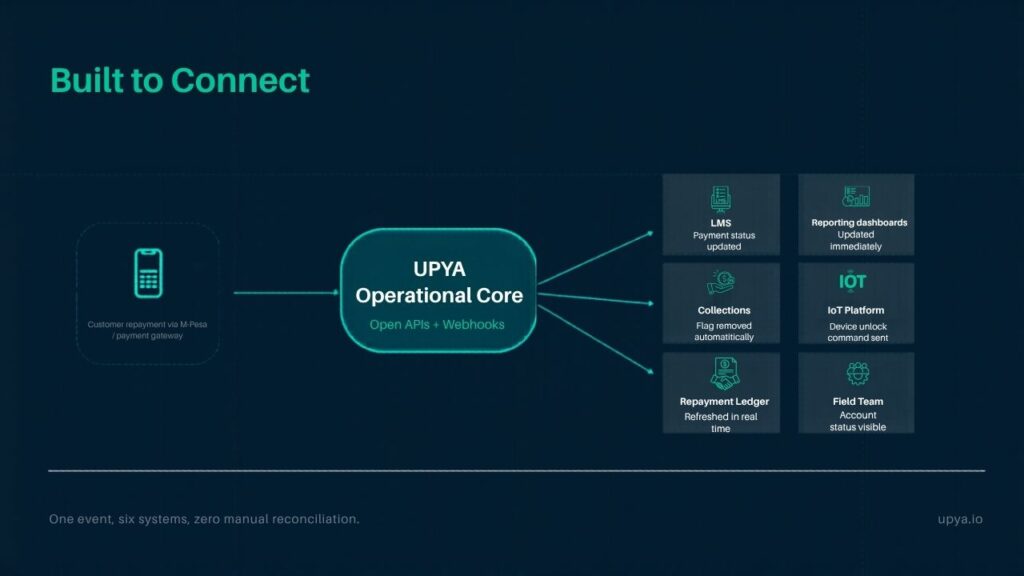
No spreadsheet, no manual reconciliation, no office team re-entering transactions between systems.
This is not simply about syncing data. It is about orchestrating workflows across multiple operational systems in real time. The systems coordinate directly instead of relying on human middleware.
Turning credit data into automated approval workflows
Credit evaluation is another area where connected systems create major operational advantages.
Many PAYGO, BNPL, microfinance, and asset-financing operators rely on third-party credit bureaus, alternative scoring providers, or telecom and payment data to evaluate customer risk. But when those systems are disconnected from onboarding and loan management workflows, approvals become slow, manual, and inconsistent.
Through Open APIs, external credit scoring providers can integrate directly into Upya Core Hub and become part of an automated approval workflow. See example below.
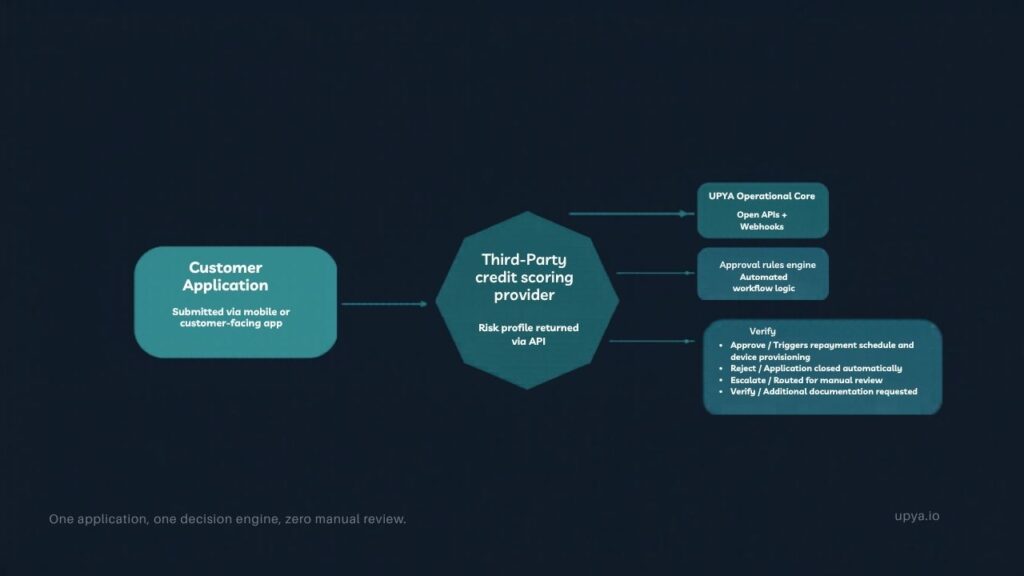
Instead of manually checking external systems and re-entering information between platforms, operators gain a streamlined decision engine connected directly to their operational stack.
This reduces onboarding delays, improves risk management, standardizes decision-making, and helps increase repayment performance by integrating real-time risk signals directly into operational workflows. The latter is becoming particularly popular amongst PAYGO Smartphones distributors and financiers.
Turning IoT alerts into operational workflows
The value of connected infrastructure becomes even more powerful when IoT systems integrate directly into field operations. This is particularly relevant for sectors such as smart metering, electricity and water utilities, cold chain, telecom towers, and e-mobility.
Many operators today deploy connected devices capable of generating real-time alerts:
- Device tampering
- Battery failures
- Connectivity issues
- Abnormal usage patterns
- Device shutdown events
The challenge is rarely receiving the alert itself. The challenge is doing something about it in the field quickly, precisely, and with visibility.
Without integration, alerts remain trapped inside manufacturer dashboards or technical monitoring systems, disconnected from operational execution.
Through Upya’s APIs and webhooks, third-party IoT platforms can push alerts directly into Upya’s solutions, automatically triggering workflow automation processes such as:
- Creating tasks or support tickets
- Assigning interventions to field agents
- Escalating unresolved issues
- Attaching customer, location, and device context
- Tracking field resolution progress
- Feeding operational analytics dashboards
This creates a direct bridge between device intelligence and field execution. Instead of manually coordinating interventions through calls or messaging groups, operators gain structured, traceable workflows that improve response times and field coordination at scale.
Building tools around a core operational platform
One of the biggest misconceptions around operational software is the idea that one platform should replace everything else.
In reality, operators often need flexibility at the edges of their ecosystem. Many companies want to build or customize their own customer-facing applications, with complete control over branding, user experience, communication flows, and customer engagement. They may require localized interfaces, custom onboarding experiences, or tightly controlled brand environments.
What usually does not make sense is rebuilding the operational core underneath those experiences from scratch.
Through Open APIs, customers can integrate their own customer-facing applications, portals, or digital experiences directly into Upya’s operational infrastructure while keeping full ownership of the frontend experience.
Their application can maintain its branding, workflows, and customer experience layer, while Upya handles the operational backbone behind it:
- Field operations management
- Workflow orchestration
- Repayment tracking
- Device integrations
- Ticketing and task management
- IoT event handling
- Operational reporting
- Real-time synchronization across systems
This approach gives operators both flexibility and operational stability: customized customer experiences connected to a scalable backend infrastructure.
Upya as a connected operational core
The same logic extends across the rest of the stack. Through Open APIs, webhook integrations, workflow automation, and interoperable services, operators can integrate Upya with:
- Mobile money providers such as M-Pesa across Africa
- Payment gateways such as Mercado Pago across Latin America
- External CRMs and ERPs
- Credit scoring and KYC providers
- IoT manufacturers and device platforms
- Reporting and analytics platforms
- Custom-built customer-facing applications
This allows operators to build workflows tailored to their operational realities while keeping systems synchronized in real time.
Because the future of last-mile operations is not about adding more disconnected tools. It is about building ecosystems where systems communicate automatically, workflows execute dynamically, and operational complexity scales without breaking coordination.
See how Upya’s open API ecosystem connects to your operational stack, book a demo.