
Growth in PAYGO Solar Home System distribution creates a problem most operators don’t anticipate. The processes that work at 500 customers break at 5,000. What holds the operation together—team coordination, manual follow-ups, spreadsheet reporting—becomes the thing holding it back.
The bottleneck is rarely strategy. It’s execution. Specifically, it’s the gap between when something needs to happen and when a person actually makes it happen.
A customer misses a payment. Someone needs to flag it, assign it, and follow up. A field agent completes an installation. That needs to be logged, verified, and linked to the customer record. A unit gets repossessed. Stock needs updating, a new customer profile needs creating, and an installation task needs assigning.
Each of these steps is straightforward in isolation. At scale, across hundreds of agents and thousands of contracts, manual coordination fails. GOGLA’s PAYGO PERFORM framework consistently shows that companies with structured, tracked processes outperform those relying on ad hoc coordination, across repayment rates, portfolio health, and operational efficiency.
Automation closes the gap between what needs to happen and what actually does.
The Challenge: Where Manual Processes Break Down
In most PAYGO SHS businesses, operations run on a combination of individual actions, team communication, and manual data entry. This works early. It doesn’t scale.
When processes depend on people remembering to act at the right time, several things go wrong simultaneously. Follow-ups with customers get missed or delayed. Response times slow when issues arise. Field agents receive inconsistent or late instructions. Locked units and stalled repayments sit unaddressed because no one has a clear view of what needs attention.
The result is not dramatic failure, it’s quiet underperformance. Repayment rates drift. Customer satisfaction drops. Managers spend time chasing status updates instead of making decisions. And the operational cost of growth rises faster than the revenue it generates.
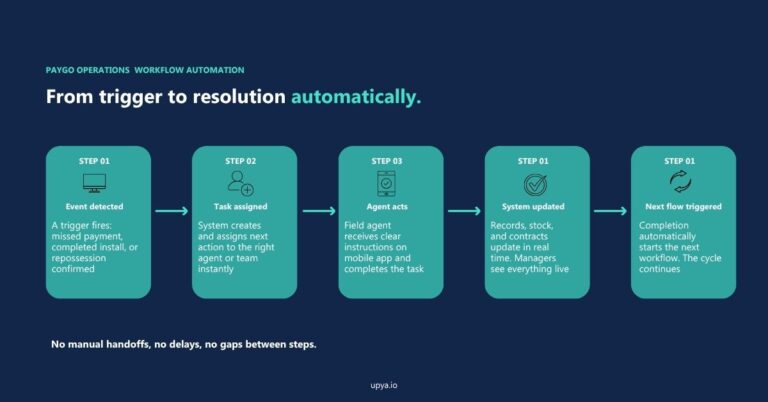
How Automation Transforms PAYGO SHS Operations
Automation in PAYGO is not about replacing people. It’s about removing the coordination overhead that slows them down and gives them clear, timely instructions so they can act without waiting for direction.
In practice, this means two things.
Triggered workflows replace manual handoffs
When a defined event occurs—a missed payment, a completed installation, a repossession confirmed—the system automatically creates the next required action and assigns it to the right person. Nothing falls through the gap between one step and the next. The agent in the field doesn’t wait for a message. The customer service team doesn’t check a spreadsheet. The system moves the process forward.
Real-time data replaces delayed reporting.
Every action logged in the field updates the central system immediately. Managers see an accurate picture of operations without chasing updates. Portfolio health, agent performance, and contract status are visible as they happen—not at the end of the week when the data finally arrives.
Together, these two capabilities change the economics of scaling. Adding more customers, more agents, or more markets no longer means adding proportional overhead. The system absorbs the coordination load that would otherwise fall on people.
Why This Matters for SHS Distributors
The operational case for automation is straightforward, but the strategic case is more important.
PAYGO SHS businesses operate in markets where margins are tight, customer circumstances change unpredictably, and the cost of operational errors compounds quickly. A delayed follow-up on a locked unit becomes a repossession. A missed installation task becomes a customer complaint. A gap in stock visibility becomes a supply problem at the wrong moment.
Automation doesn’t eliminate these risks. It reduces the window in which they can develop. Faster response times mean fewer escalations. Consistent agent coordination means fewer errors. Accurate real-time data means managers catch problems before they become portfolio damage.
This is what sustainable scaling looks like in PAYGO SHS. Not more people doing more manual work, but the same team, operating with better tools, handling a larger and more complex operation with the same level of control.
At Upya, we built our workflow automation around this reality. Distributors configure the triggers and actions that match their operations, from payment follow-ups to field agent task assignment to stock updates and the system handles the coordination from there.
Conclusion
Manual processes are not a sign of a poorly run PAYGO business. They’re a sign of a business that hasn’t yet reached the scale where automation becomes necessary. Most operators hit that point sooner than they expect.
When they do, the question is not whether to automate, it’s which processes to automate first, and whether the platform can handle the complexity of the operation as it grows.
The distributors scaling successfully in PAYGO SHS are not working harder than their competitors. They’re working with better systems. Automation is how they get there.
See how Upya´s automated workflow works in practice